The 90-Day Success Workbook: A Strategic System for Designing Your Next Quarter
Most planning tools promise transformation but deliver little more than blank pages and good intentions. The difference between a plan that collects dust and one that drives real progress often comes down to structure, rhythm, and accountability. The 90-Day Success Workbook is designed to close that gap. It is a 30-page guided planner that helps you move from vague ambition to clear, measurable action within a 90-day cycle. For anyone who works in goal-oriented environments—entrepreneurs building a business, creators developing a content strategy, professionals navigating a complex project, or coaches guiding clients—this workbook offers a practical framework for making decisions that actually lead somewhere.
Why a 90-Day Timeframe Matters for Strategic Progress
A year is too long for most people to sustain focus. A week is too short to build meaningful momentum. The 90-day cycle sits in a sweet spot where you can pursue something ambitious enough to matter, yet near enough to maintain motivation and course-correct when needed. This timeframe aligns naturally with business quarters, project sprints, and personal development cycles. Using The 90-Day Success Workbook within this rhythm forces you to think in terms of outcomes rather than activities. Instead of asking "What should I do today?" you begin to ask "What needs to be true 90 days from now, and what does that mean for how I spend my time this week?" That shift in perspective is one of the most valuable strategic moves you can make.
The workbook leverages this 90-day constraint to help you separate the essential from the merely urgent. When you know you have only twelve weeks to achieve a specific result, prioritization becomes less theoretical and more necessary. You start making decisions based on leverage, not convenience.
What the Workbook Offers Beyond Ordinary Planning
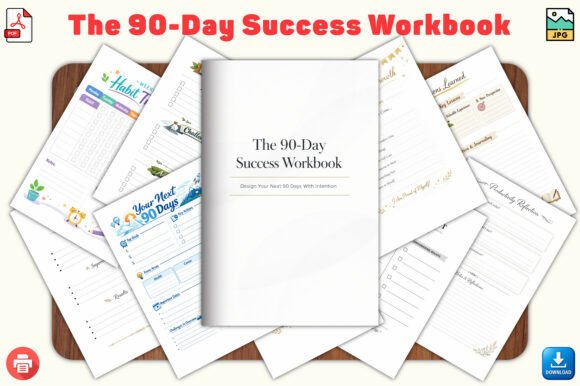
The 90-Day Success Workbook includes vision and goal-setting pages, a 90-day strategic planning framework, weekly planning layouts, a habit tracking system, reflection and progress check-ins, mindset and accountability worksheets, productivity focus pages, and a final 90-day review with next-step planning. Each element serves a distinct function within a coherent system. The vision pages help you define what success actually looks like, not in abstract terms but in concrete, observable outcomes. The weekly layouts force you to translate that vision into executable tasks without overwhelming detail. The habit tracking pages recognize that sustainable progress depends on daily behaviors, not just one-time efforts.
What distinguishes this workbook from generic planners is its emphasis on reflection and course correction. The check-in pages are not afterthoughts. They are designed to help you assess what is working, what is not, and what needs to change before you drift too far off course. For decision-makers who value learning and iteration, these sections are where the real value lives.
Using the Workbook to Align Goals with Daily Decisions
A common failure in goal-setting is the gap between high-level aspirations and everyday choices. You might know you want to grow your business, but when Tuesday morning arrives, the day gets consumed by email and minor tasks. The 90-Day Success Workbook bridges that gap by requiring you to define your 90-day outcome first, then work backward through weekly priorities and daily habits. This cascading structure ensures that each small decision connects to a larger purpose.
Consider an entrepreneur launching a new product. The 90-day outcome might be a completed beta with ten paying users. The weekly priorities could include customer discovery calls, prototype iterations, and landing page testing. The daily habits might involve writing one outreach message per day or reviewing user feedback for fifteen minutes each morning. Without the workbook, these activities risk becoming scattered or reactive. With it, they become part of a deliberate sequence.
The same logic applies to other use cases. A content creator aiming to build an audience might set a 90-day goal of publishing twelve high-quality pieces and growing email subscribers by a specific number. Weekly planning ensures consistent output. Habit tracking reinforces the discipline of showing up even when motivation fluctuates.
The Role of Habit Tracking and Reflection in Sustained Progress
Habits are the engines of long-term results, but they are easy to neglect when you are focused on big-picture planning. The 90-Day Success Workbook dedicates space specifically to habit tracking because small, repeated actions compound into substantial outcomes. The trick is not to track everything, but to track the few behaviors that directly support your 90-day goal. If your objective is to improve operational efficiency, tracking one habit like "review daily priorities each morning" might be more valuable than tracking ten unrelated habits.
The reflection pages serve a different but equally important function. They create a structured pause where you can step back from daily busyness and assess trajectory. Are you moving toward your goal or away from it? What assumptions have changed? What feedback have you received that should alter your approach? Without these check-ins, it is easy to mistake activity for progress. With them, you maintain the ability to adapt before you waste weeks going in the wrong direction.
When and How to Approach the 90-Day Cycle
The workbook is most useful when you start at the beginning of a natural cycle—the start of a quarter, the launch of a project, the beginning of a new season, or after a significant milestone. However, you do not need to wait for a calendar date. Any moment when you feel the need for more focus and less scatter is a good time to begin. The key is to invest time upfront in the vision and goal-setting pages. Rushing through this phase undermines everything that follows.
Before you start, take an hour to clarify what matters most right now. What is the one outcome that would make this 90-day period feel successful? Write it down in concrete terms. Then use the strategic planning framework to identify the key actions that will drive that result. Be realistic about what you can accomplish in twelve weeks. Overcommitting is a common mistake that leads to frustration and abandoned plans.
Once the plan is set, commit to a weekly review routine. This does not need to be long—fifteen to thirty minutes is enough to assess progress, adjust priorities, and update your habit tracking. The consistency of the review matters more than the duration. The final 90-day review is an opportunity to extract lessons and set the stage for the next cycle. This is where the workbook becomes a tool for continuous improvement rather than just a one-time exercise.
What to Consider Before Relying on a Structured Workbook
Any planning tool is only as effective as the clarity you bring to it. The most significant risk of using The 90-Day Success Workbook without clear goals is that you generate a well-organized plan for something that does not matter. The structure can create a false sense of progress. You might fill in all the pages, track your habits, and complete your weekly reviews, yet still end up in the wrong place because you never questioned whether the goal itself was worth pursuing.
Another risk is treating the workbook as a checklist rather than a thinking tool. The pages are designed to provoke reflection, not just documentation. If you rush through them without genuine thought, you will miss the strategic value. The habit tracking can also become a source of guilt if you treat missed days as failures rather than data. Use it to learn about your patterns, not to judge yourself.
Finally, remember that no workbook can replace the need for external feedback, market validation, or honest conversations with colleagues and mentors. The 90-Day Success Workbook is a complement to real-world engagement, not a substitute for it. Use it to organize your thinking and actions, but stay connected to the environment you are operating in.
Practical Examples for Different Use Cases
For an entrepreneur launching a new service, the workbook might capture a 90-day objective of securing five retained clients. Weekly priorities could include refining the offer, conducting outreach, and building a referral system. Habit tracking might focus on daily outreach actions and weekly proposal submissions. The reflection pages would help identify which outreach channels are most effective and whether the pricing model needs adjustment.
For a marketing professional aiming to improve campaign performance, the 90-day goal might be increasing conversion rates by a specific percentage. Weekly priorities could include analyzing past campaign data, running A/B tests, and optimizing landing pages. Habit tracking might involve daily review of analytics or weekly documentation of learnings. The structure helps maintain focus on the metrics that matter rather than getting lost in tactics.
For a freelancer seeking to build a sustainable practice, the 90-day outcome might be achieving a target monthly income from recurring clients. Weekly priorities could include networking, content creation, and proposal follow-ups. The habit tracking pages would reinforce the discipline of consistent outreach, while the reflection check-ins would surface patterns about which types of clients yield the best relationships and revenue.
How to Get the Most Out of the Workbook Intentionally
Start by treating the vision pages as a commitment device, not a wish list. Write your 90-day outcome in specific terms that you can verify at the end of the cycle. Use the weekly planning layouts to break that outcome into manageable chunks, but leave room for adjustment. The world will change during your 90 days, and your plan should be flexible enough to accommodate new information.
Use the habit tracking system to focus on no more than three behaviors that directly support your goal. Tracking more than that dilutes attention. The reflection pages are best used as a weekly practice where you ask yourself three questions: What is working? What is not working? What will I do differently next week? The final review should be a candid assessment of what you achieved, what you learned, and what you want to carry forward into the next 90-day cycle.
The workbook also works well when used with a partner or team. Sharing your 90-day goal with someone else creates external accountability and opens the door for feedback. Coaches and mentors can use it as a structured framework for client sessions, ensuring that each meeting builds on the previous one and that progress is documented over time.
Long-Term Value Beyond 90 Days
The 90-Day Success Workbook is not just a one-time planning tool. Used consistently across multiple cycles, it becomes a record of your strategic thinking and decision-making patterns. You can look back at previous workbooks to see which goals you pursued, which approaches worked, and where you repeatedly struggled. This historical perspective is invaluable for growth. It turns planning from a reactive activity into a deliberate practice that improves with each iteration.
Over several cycles, you will likely notice your ability to set realistic goals improving. You will become better at estimating what you can accomplish in 90 days and more honest about the trade-offs involved. The workbook trains you to think in terms of outcomes, habits, and learning—three pillars that support sustained progress in any domain. Whether you are building a business, advancing your career, or pursuing personal development, this structured approach helps you design your next 90 days with clarity, focus, and purpose.
The measure of a good planning tool is not whether it makes you feel productive in the moment, but whether it helps you achieve better results over time. The 90-Day Success Workbook delivers on that measure when used with intention. It does not promise shortcuts or magic. It offers a system that, when combined with honest reflection and consistent action, can help you turn your goals into real, measurable outcomes.