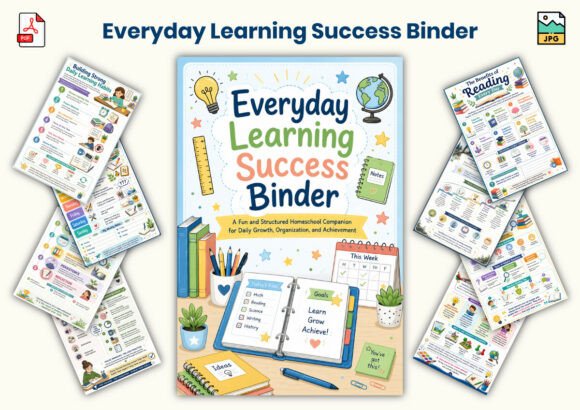
Everyday Learning Success Binder: A Tool for Structured Growth
How the Binder Supports Learning Workflows
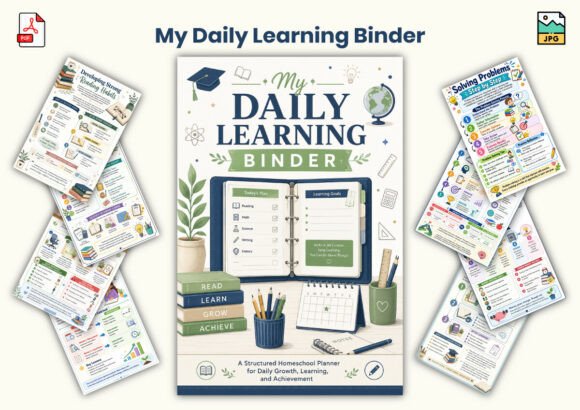
The Everyday Learning Success Binder provides a 31-page framework that guides learners through a complete workflow: from identifying objectives to applying strategies and reviewing outcomes. Each page serves a distinct function within a cycle of planning, action, and reflection. For example, the goal-setting worksheets are placed early in the binder, followed by daily habit trackers, then progress logs, and finally reflection pages. This sequence mirrors effective learning processes used in educational psychology, where feedback loops are essential for skill acquisition. A homeschooler might begin each week by setting three academic goals, use the daily habit pages to check off focused study sessions, and close the week with a reflection page that captures what worked and what needs adjustment. The binder’s 6×9-inch size makes it portable for use at a desk, on a commute, or during breaks, so the workflow integrates smoothly into real-world routines.
Key Features for Organization and Motivation
The binder’s design emphasizes both structure and engagement. Its 31 unique interior pages include interactive worksheets, reflection pages, and progress tracking sections. The layout uses a clean, professional aesthetic with a homeschool-inspired look, featuring ample white space and clear section headers that reduce cognitive load. Motivational elements appear in the form of confidence-building prompts and reading motivation trackers. For instance, a page titled “My Learning Wins” asks users to list three accomplishments each day, which reinforces positivity and momentum. The PDF and JPG formats are print-ready, allowing users to reprint pages as needed for repeated use over multiple weeks or subjects. This versatility makes the binder not a one-time worksheet but a reusable system for ongoing learning management.
Applying the Binder in Different Learning Environments
The 📚 Everyday Learning Success Binder is adaptable across several settings. In a homeschool environment, it functions as a central planner that aligns with curriculum goals. A parent can print copies for each child and use the goal-setting pages to coordinate lessons across subjects. In a classroom, teachers can incorporate the binder as a personal portfolio tool for students to track their own progress, reducing the need for external monitoring. Independent learners—such as adults picking up a new language or side skill—benefit from the time management pages that break large projects into daily actions. Even business owners studying industry trends can use the focus and productivity worksheets to maintain consistent learning without burnout. The binder’s structure removes guesswork from daily study, making it suitable for anyone managing competing priorities.
Building Positive Learning Habits Through Consistency
Consistency remains one of the strongest predictors of long-term learning success. The binder includes dedicated pages for daily learning habits and time management. Each habit page contains a simple checklist with space to record study duration, subject area, and an energy rating. Over time, users can review these logs to identify patterns: for example, noticing that focus improves in the morning or that certain subjects require shorter but more frequent sessions. The Everyday Learning Success Binder reinforces these habits by providing immediate visual feedback—completed check marks or color-coded entries—which taps into the brain’s reward system. A student who schedules 20 minutes of vocabulary review each day and tracks it in the binder is more likely to sustain that habit than one who relies on memory alone. This is where the binder’s print-ready nature shines, as physical tracking often carries more psychological weight than digital checklists.
Enhancing Focus and Productivity with Structured Layouts
Focus and productivity are not innate traits but skills that require scaffolding. The binder’s focus pages use a “block and break” layout: a dedicated section for a primary task, followed by a scheduled pause. Users can list distractions in a sidebar and then brainstorm solutions during reflection. For example, a learner struggling with phone interruptions might set a focus timer for 25 minutes, document the urge to check social media, and later write a strategy—like placing the phone in another room. This reflective practice transforms focus from a vague intention into a actionable skill. The Everyday Learning Success Binder also includes a productivity tracker where users rank their output on a scale from low to high. Over weeks, these entries reveal which environments, times of day, or study methods yield the best results. Such data-driven insights are more reliable than general advice, as they are tailored to the individual’s experience.
Understanding Learning Styles to Improve Retention
The binder addresses the concept of learning styles not as fixed categories but as preferences that can be leveraged for better retention. One page asks users to reflect on whether they learn best through reading, hands-on activities, discussions, or visuals. It then prompts them to adapt upcoming study sessions accordingly. For instance, a visual learner reviewing biology terms might draw diagrams in the margin of the binder’s progress tracker. An auditory learner could use the reflection pages to summarize concepts aloud and note key points. This metacognitive exercise helps learners become more aware of their own processes. The Everyday Learning Success Binder also includes a page on memory and learning skills, where users can experiment with spaced repetition or mnemonic devices. By logging which techniques work best for different subjects, learners build a personalized toolkit that evolves with their needs.
Confidence Building Through Reflection Activities
Confidence grows when learners see evidence of their progress. The binder’s reflection pages are designed to capture small wins and setbacks in a balanced way. A typical reflection prompt asks, “What did I learn today that I didn’t know yesterday?” followed by “What challenge did I face and how did I handle it?” This format normalizes struggle as part of the journey while emphasizing growth. Over time, flipping back through earlier pages reveals how far the learner has come—a visual timeline of skill development that counteracts feelings of stagnation. One user might note that in week one, they struggled with basic algebra equations, but by week four, they were solving multi-step problems confidently. The Everyday Learning Success Binder also includes a dedicated confidence-building section with affirmations and strategic prompts like “List three strengths you used today.” This structured positivity helps learners internalize their capabilities rather than relying on external praise.
Tracking Progress and Overcoming Challenges
Progress tracking in the binder moves beyond simple checkmarks. The progress tracking pages include bar charts, timelines, and a section for notes on obstacles. For example, a student learning piano might track the number of scales practiced each day and note that fatigue set in after 15 minutes. That observation leads to a strategy change: shorter practice sessions with a focused goal. The binder also has a page titled Learning Challenges where users list specific difficulties—such as understanding verb conjugations or remembering historical dates—and brainstorm multiple solutions. This problem-solving approach reframes obstacles as puzzles rather than failures. A professional learning a new software tool could use the challenge page to document error messages and then research fixes, creating a personal troubleshooting guide. The Everyday Learning Success Binder thus turns setbacks into data points, making the learning process more analytical and less emotional.
Memory and Learning Skills Integration
Memory retention often requires deliberate practice, and the binder dedicates space to techniques like retrieval, elaboration, and interleaving. One page encourages users to write a brief summary of a concept without notes, then check for missing details. Another prompts them to connect new information to something they already know. For instance, a learner studying anatomy might link the structure of a cell to the system of a library—each organelle has a function just as each section of a library serves a purpose. The Everyday Learning Success Binder also includes a spaced repetition planner where users schedule review intervals: after one day, one week, and one month. This systematic approach is backed by research on the forgetting curve and helps move information from short-term to long-term memory. The learning skills section provides a reference for these methods, so users can gradually adopt them without feeling overwhelmed.
Real-World Relevance and Lifelong Application
The binder’s value extends beyond formal education. Adults pursuing continuing education, career changes, or personal hobbies find the Everyday Learning Success Binder useful for managing self-directed study. A hobbyist learning carpentry might use the goal-setting pages to plan projects, the daily habit tracker to log practice time, and the reflection pages to evaluate techniques. A business owner studying market trends can apply the focus and productivity worksheets to balance learning with daily operations. The binder is not tied to any specific subject, which allows its structure to adapt across domains. Its 31-page format is long enough to provide variety but short enough to avoid intimidation. Users often report that the act of flipping through physical pages—rather than swiping on a screen—creates a sense of ritual that reinforces commitment. This tactile element, combined with the structured content, supports the kind of consistent, reflective practice that underpins lifelong learning.
Considerations for Maximizing Use
To get the most from the binder, it helps to approach it as a companion rather than a strict regimen. Users should feel free to skip or adapt pages based on current needs. For example, if focus is already strong, the focus pages might become optional. Similarly, the goal-setting pages can be revisited monthly instead of weekly. The binder’s print-ready design means users can print only the sections they need, reducing wasted paper. Those who prefer digital workflows might scan pages and fill them on a tablet, though the physical format tends to offer deeper engagement. The high-quality PDF and JPG files ensure clean prints, and the 6×9-inch size fits standard binders or can be hole-punched for customization. Because the binder covers diverse areas—from learning strategies to memory skills—users can rotate their focus (e.g., one week emphasizing reflection, another emphasizing challenge tracking). This flexibility prevents the binder from becoming yet another routine task and instead keeps it a responsive tool for growth.