2026 Mind Reset Workbook – Refresh Your Mind Start the Year with Clarity
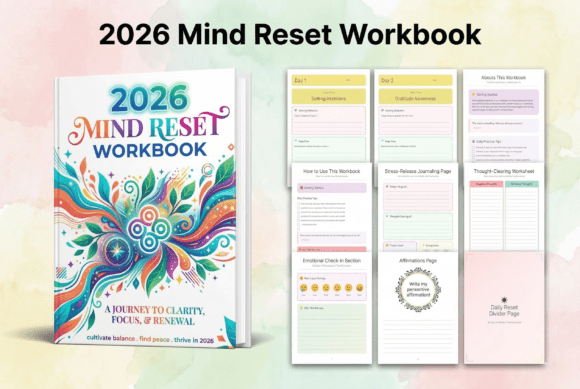
There’s something about the turning of a year that makes you want to pause and take stock. Maybe you’ve been carrying mental clutter from the past twelve months—unfinished thoughts, unresolved stress, or patterns you know aren’t serving you anymore. The 2026 Mind Reset Workbook is a 120-page, no-bleed format tool designed to help you do exactly that: reflect, release, and rebuild a mental framework that feels lighter and more intentional. It’s not about fixing everything overnight. It’s about creating space for what actually matters.
What the 2026 Mind Reset Workbook really offers
At its core, this workbook is a guided space for reflection and recalibration. It includes mind reset reflection pages that help you examine past thoughts and habits, let-go release exercises for identifying stress and negative beliefs, mindset reframing worksheets to turn limiting thoughts into empowering ones, a personal growth goal planner, and vision mapping pages. It’s structured so you can work through it at your own pace, without feeling rushed or overwhelmed. The no-bleed format means you can use pens, markers, or highlighters without worrying about ink bleeding through—practical for those who like to color-code or add notes in the margins.
When the weight of the past year feels heavy
Imagine sitting down in January, coffee in hand, and realizing just how much mental energy you’ve been spending on things that no longer matter—old grudges, work stress, self-doubt. The let-go release exercises in the workbook are designed for exactly that moment. They help you name what’s weighing you down, then guide you through releasing it. Not in a vague, spiritual way, but in a concrete, actionable way. You might write down a recurring worry, then work through prompts that help you see it from a different angle. It’s the kind of exercise that leaves you feeling like you’ve cleared off a messy desk—except it’s your mind.
For someone who’s been in a demanding job for years, this can be a relief. The workbook doesn’t ask you to pretend everything is fine. It acknowledges that life is messy and that resetting doesn’t mean erasing the past—it means learning to carry it differently.
Different people, different entry points
One of the strengths of this workbook is that it works across different life stages and situations. A university student in their mid-twenties might use it to break free from perfectionism patterns that have followed them since high school. A parent in their forties might use it to carve out a personal vision beyond caregiving responsibilities. A freelancer who feels scattered might use the vision mapping pages to clarify their next career move. The prompts are broad enough to apply to various contexts, yet specific enough to feel relevant.
Consider someone who has just gone through a major life transition—moving cities, ending a relationship, changing careers. The mindset reframing worksheets can be especially useful here. Instead of feeling stuck in thoughts like “I’ve wasted time” or “I’m starting from zero,” the workbook helps you reframe those experiences as data points, not verdicts. You begin to see transitions as fertile ground rather than setbacks.
Practical scenarios where it fits naturally
One of the most common uses for a workbook like this is during a personal retreat weekend—whether that’s a literal getaway or a Saturday morning with no plans. You can work through several sections in one sitting, or spread it out over a week. Some people use it in the evenings as a wind-down ritual, replacing doom-scrolling with reflective writing. Others keep it on their desk and pull it out during lunch breaks or after a stressful meeting.
It also works well in small group settings. A few friends or colleagues might go through it together and discuss their insights. That kind of shared reflection can deepen relationships and provide accountability. But it’s just as effective used solo—there’s no pressure to share unless you want to.
If you’re someone who has tried journaling in the past but found it too open-ended, the structured prompts in the 2026 Mind Reset Workbook offer just enough guidance to keep you moving without feeling restrictive. That balance is hard to find in many journals, which tend to either be too vague or too prescriptive.
Who might find it less useful
No tool is perfect for everyone, and it’s worth being honest about that. If you prefer completely unstructured freewriting, you might find the prompts constraining. If you’re looking for a workbook that focuses heavily on productivity or habit tracking, this one leans more toward mindset and emotional clarity. It’s not a planner in the traditional sense—it’s a reset tool. The goal planner and vision mapping pages are there, but they’re part of a broader reflective process rather than a standalone productivity system.
Also, if you’re in a state of acute crisis or dealing with untreated mental health conditions, a workbook like this is best used as a complement to professional support, not a replacement. It’s designed for maintenance and growth, not for clinical intervention.
How to get the most out of it
People often ask whether they should complete the workbook in order or jump around. There’s no wrong way, but starting with the reflection pages can help you build awareness before you move into releasing and reframing. The vision mapping pages work well toward the end, once you’ve cleared mental clutter and have a clearer sense of what you actually want.
One practical tip: keep a pen you actually enjoy writing with nearby. The no-bleed format means you can use a favorite fountain pen or a bold marker without worry. That small sensory detail—the feel of a good pen on paper—can make the experience more pleasant and encourage consistency.
You might also consider pairing the workbook with a quiet morning routine. Even fifteen minutes with one prompt can shift your mindset for the entire day. Some users have noted that revisiting the same exercise after a few months reveals how much their thinking has evolved—something that’s encouraging to see in your own handwriting.
Why the 2026 version feels timely
Year after year, people set resolutions that fizzle by February. The 2026 Mind Reset Workbook doesn’t rely on resolutions. It’s built around reflection and reframing, which are more sustainable approaches to change. By the time you’ve worked through the exercises, your goals emerge from a place of clarity rather than pressure. That’s a subtle but important difference.
In a culture that often tells you to do more, be more, and optimize everything, this workbook offers a counterbalance: pause, release, realign. It’s not about becoming a new person. It’s about remembering who you are underneath the noise.
Final thoughts on choosing a reset tool
If you’ve been feeling mentally foggy, stuck in repetitive thought patterns, or just ready for a fresh start, the 2026 Mind Reset Workbook provides a structured yet flexible path forward. It’s suitable for anyone who appreciates guided reflection and wants to approach the new year with intention rather than reaction. The real value isn’t in the pages themselves—it’s in what you discover as you fill them. That kind of clarity can’t be rushed, but it can be invited. And that’s exactly what this workbook helps you do.