Product Research Success Guide – A Practical Workbook for Identifying Profitable Opportunities
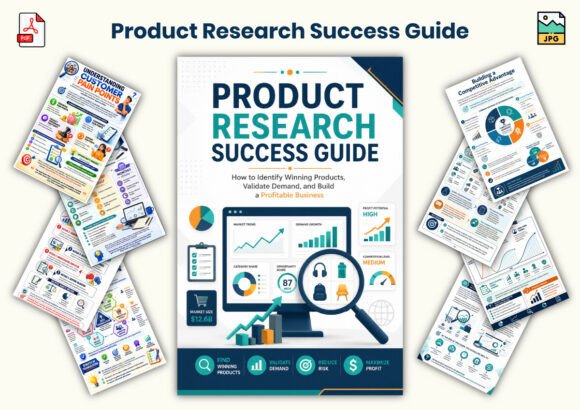
For anyone selling products online, the difference between a successful launch and a costly misstep often comes down to how thoroughly the product research phase is handled. Yet, many entrepreneurs and small business owners lack a structured approach to evaluating demand, competition, and profitability before committing time and capital. The Product Research Success Guide is a 26-page workbook designed to bridge that gap. It combines educational content, worksheets, checklists, case studies, and reflection exercises in a clean infographic-style layout. Measuring 6 by 9 inches and available as high-quality PDF and JPG files, it aims to guide users through the complete product research process—from opportunity discovery to actionable planning.
This article offers a balanced evaluation of the guide, exploring what it includes, who might benefit from it, and where alternative approaches may be worth considering. The goal is to help you determine whether this resource aligns with your specific goals, experience level, and way of working.
What the Product Research Success Guide Offers
The guide is structured around several core sections that mirror a typical product research workflow. It begins with fundamentals, introducing key concepts and terminology that underpin effective research. From there, it moves into opportunity discovery methods, helping users identify potential product niches or gaps in the market. Later sections cover market demand evaluation, competitive analysis, profitability assessment, and product validation techniques. Each of these areas is supported by practical tools such as research checklists, action planning worksheets, and opportunity tracking pages.
What sets this workbook apart from many generic business templates is its emphasis on reflection and evaluation. Instead of simply providing checklists, it encourages users to pause and assess their findings critically. Case studies and examples illustrate how the concepts apply in real-world scenarios, making the content more relatable and actionable. The design follows an infographic marketing aesthetic, which means information is presented visually with icons, diagrams, and concise text blocks rather than dense paragraphs. This approach can make the material more accessible and easier to revisit.
Why Someone Might Consider This Guide
The primary appeal of the Product Research Success Guide lies in its structure. For individuals who feel overwhelmed by the open-ended nature of product research, a step-by-step workbook provides clarity and direction. Rather than starting from scratch or relying on scattered online advice, users can follow a logical sequence of activities that build on one another. This can reduce the risk of skipping critical steps, such as validating demand before assessing competition or evaluating profitability before committing to a product idea.
Another reason to consider the guide is its focus on practical application. The inclusion of worksheets, checklists, and action planning pages means the resource is not just something to read—it is something to use. For entrepreneurs who prefer learning by doing, this hands-on format can accelerate the research process and improve the quality of decisions. The reflection exercises add an additional layer, prompting users to document assumptions, test hypotheses, and adjust their approach based on evidence.
The guide also targets a broad audience: ecommerce sellers, online entrepreneurs, small business owners, marketers, and product researchers. This breadth suggests that the content is designed to be adaptable rather than overly niche. Whether you are selling on Amazon, running a Shopify store, or testing a new product line for an existing brand, the underlying research principles remain relevant.
Benefits, Tradeoffs, and Considerations
One of the strongest benefits of the Product Research Success Guide is its compact yet comprehensive format. Twenty-six pages is enough to cover the essential stages of research without becoming overwhelming. Users can work through the guide in a few focused sessions rather than slogging through a lengthy textbook. The high-resolution PDF and JPG files make it easy to print, annotate, or use digitally, depending on personal preference.
The visual design is another advantage. Infographic-style layouts help users grasp relationships between concepts more quickly than plain text. For example, a flowchart showing the research process from discovery to validation can serve as a quick reference during analysis. The use of icons, color coding, and white space also reduces cognitive load, which is helpful when dealing with complex evaluations like market sizing or competitive positioning.
However, there are tradeoffs to consider. The guide is a workbook, not a tool or database. It does not provide real-time market data, competitor sales estimates, or keyword analysis. Users will need to gather their own data from external sources such as Amazon, Google Trends, social media, or supplier platforms. The guide helps structure and interpret that data, but it cannot replace the research itself. For individuals who expect a plug-and-play solution that automatically identifies winning products, this workbook may feel incomplete.
Another consideration is the level of depth. Twenty-six pages means each topic is covered concisely. While the guide covers the full research workflow, users who need deep dives into specific areas—such as advanced competitive analysis techniques or financial modeling for profitability—may find the coverage introductory. The guide prioritizes breadth over depth, which is a deliberate tradeoff that serves novices well but may leave experienced researchers wanting more.
Finally, the infographic style, while visually appealing, may not suit everyone. Some users prefer detailed explanatory text with footnotes and references. If you learn best by reading long-form content or need extensive theoretical background, the concise, visual format might feel too superficial. It is worth reviewing sample pages if available to assess whether the presentation style matches your learning preferences.
When the Product Research Success Guide Is a Strong Fit
The guide is particularly well suited for entrepreneurs who are new to product research or who have been using ad hoc methods without consistent results. If you have ever felt uncertain about whether you are asking the right questions or covering all the bases before launching a product, the structured workflow can provide much-needed confidence. The checklists and action plans serve as a safety net, reducing the likelihood of overlooking important factors like seasonality, margin erosion, or hidden competition.
Another strong fit is for small teams or solo operators who need a shared framework. If you are working with a partner, freelancer, or virtual assistant, the guide can serve as a common reference. Everyone uses the same worksheets and evaluation criteria, which makes collaboration more efficient and reduces misunderstandings. The printable format also supports offline work, which can be useful during brainstorming sessions or when internet access is limited.
The guide also works well for those who value reflection and iteration. The included reflection and evaluation pages encourage users to look back at past research efforts, identify what worked and what did not, and refine their process over time. This builds a habit of continuous improvement that goes beyond any single product launch.
When Alternatives May Be Worth Considering
If your product research needs are highly specialized, you may benefit from a resource that goes deeper into your specific niche. For instance, sellers in categories with complex regulatory requirements (such as baby products, medical devices, or electronics) may need guides that address compliance, certification, and liability considerations in detail. The Product Research Success Guide covers general principles but does not provide category-specific guidance.
Another situation where alternatives may be preferable is when you need dynamic, data-driven tools rather than a static workbook. Subscription-based research platforms offer real-time analytics, trend tracking, and competitive intelligence that a PDF workbook cannot provide. If your research process relies heavily on data scraping, software tools, or automated validation, then a workbook might serve as a complementary resource rather than a primary solution.
Experienced product researchers who already have a well-established methodology may find the guide redundant. If you have developed your own checklists and workflows over years of practice, the guide may not introduce many new concepts. In that case, you might prefer advanced resources such as industry-specific case study collections, mastermind groups, or consulting services that address nuanced challenges.
Finally, if your preferred learning format is video, audio, or interactive online courses, a static PDF workbook may not engage you as effectively. Some people absorb information better through watching demonstrations or participating in live workshops. For them, a video-based course covering the same topics could yield better results.
Practical Decision-Making Insights
To determine whether the Product Research Success Guide is right for you, start by assessing your current research process. Ask yourself: Do I have a repeatable, documented method for evaluating product ideas? Do I consistently test demand, competition, and profitability before making decisions? If the answer to either question is no, the guide offers a clear path forward.
Next, consider your time and learning style. If you can dedicate a few focused sessions to work through the worksheets and apply them to a real product idea, you are likely to see tangible benefits. The value of the guide increases with use—it is not a passive read but an active tool. Set aside time to complete the action planning pages and reflection exercises, not just skim the checklists.
It may also help to think of the guide as a complement to other resources rather than a replacement. Pairing it with market research tools, supplier databases, and competitor analysis software can create a robust system. The guide provides the structure; external tools provide the data.
Finally, consider the cost relative to the potential downside of poor product decisions. A single misguided product launch can cost thousands of dollars in inventory, marketing, and opportunity cost. Investing in a structured research process is a relatively low-cost way to reduce that risk. For many entrepreneurs, the guide pays for itself if it prevents even one bad decision.
Final Thoughts
The Product Research Success Guide addresses a genuine need among ecommerce sellers and entrepreneurs: a structured, practical, and visually engaging way to conduct product research. Its 26-page format balances comprehensiveness with usability, and the inclusion of worksheets, checklists, and reflection exercises supports active learning and application. While it is not a substitute for real-time data tools or deep-dive resources for specific categories, it serves as a solid foundation for building a repeatable research process.
For those who are new to product research or who want to bring more discipline to their approach, this workbook is worth evaluating. Its value depends largely on how it is used—as an occasional reference or as an integral part of your product development workflow. By aligning the guide with your own goals, experience level, and preferred way of working, you can decide whether it is the right tool to help you identify profitable opportunities with greater confidence.