STEM Activity Book for Kids: Hands-On Learning
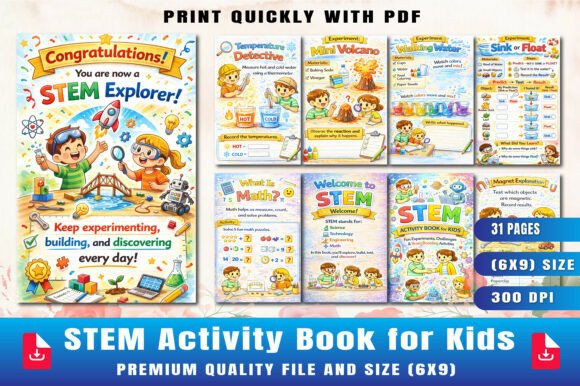
When it comes to nurturing curiosity, creativity, and critical thinking in children, few resources are as effective as a well-designed STEM Activity Book for Kids. This 30-page eBook brings together science experiments, engineering challenges, coding basics, and math puzzles in a format that’s ready to print or use digitally. Whether you’re a teacher planning classroom activities, a parent looking for at-home enrichment, or a homeschool educator seeking structured projects, this book offers a practical way to introduce STEM concepts without overwhelming young learners.
The activities are intentionally simple yet open-ended. Children can test objects in a sink or float experiment, observe a walking water demonstration, create a mini volcano reaction, explore magnetism with common household items, investigate shadows, and track plant growth over time. These science activities don’t require expensive materials — most use items like jars, paper clips, baking soda, and sunlight. The emphasis is on asking “what if?” and recording observations, which builds a foundation for scientific thinking.
Engineering challenges push kids to design and build. A paper car, tall tower, bridge strength test, boat building challenge, and invention design lab encourage trial and error. The problems are framed as questions: “Can you build a bridge that holds ten pennies?” or “How tall can you make a tower using only paper and tape?” This process of testing and iterating mirrors real-world engineering and helps children develop resilience and problem-solving skills.
Technology sections introduce coding concepts without screens — step-by-step logic instructions, sequencing activities, and critical thinking scenarios. Children learn to think like programmers by breaking down tasks and describing each step clearly. Math activities include measurement challenges and shape hunts, making abstract concepts tangible. For example, kids might measure the length of their shadow at different times of day or identify geometric shapes in their environment.
Why This STEM Activity Book Stands Out
The market is full of activity books, but this one earns attention because of its focused structure. Each of the four STEM areas is covered with multiple hands-on projects, and the 6×9-inch page size is portable enough for travel yet large enough for drawing and writing. The included JPG files make it easy to share individual pages on tablets or learning platforms. For creators, designers, and small business owners, this format also allows for easy customization — you can rebrand the pages, add your own instructions, or combine activities into themed lesson plans.
What makes this book especially useful is its emphasis on 21st-century skills. Critical thinking, creativity, collaboration, and communication are woven into every challenge. When children work through the boat building challenge, they aren’t just following steps — they are hypothesizing about buoyancy, testing materials, and discussing results with peers or parents. The invention design lab invites open-ended creativity: “Imagine a machine that helps plants grow faster. Draw it. Label its parts. Explain how it works.” This kind of task develops both technical knowledge and imaginative thinking.
Creative Applications for Different Audiences
Different users will find unique ways to adapt the STEM Activity Book for Kids. Here are several approaches that work well in real scenarios:
For Educators and Classroom Teachers
Use the book as a supplement to your existing curriculum. The sink or float experiment can reinforce a unit on density; the walking water activity introduces capillary action. Print individual challenge cards and set up stations around the room. Students rotate every 15 minutes, recording data in science notebooks. The build-a-paper-car engineering challenge works great as a group project — teams compete to see whose car travels farthest. Because the activities are short and require minimal setup, you can fit one into a 30-minute block or stretch it across a week of inquiry.
Teachers can also use the math sections for early finishers. The shape hunt activity asks kids to find and sketch shapes in the classroom, then count angles or sides. This turns passive observation into active exploration. For older elementary students, the coding logic exercises can be done without a computer — use the step-by-step instructions to guide a partner through a simple task, like making a sandwich. This unplugged approach makes computer science accessible to all.
For Homeschool Families
Homeschoolers often need resources that are self-contained and flexible. This book fits nicely into a morning basket or project-based learning block. You might choose one engineering challenge per week and spend a few days testing different designs. The plant growth observation activity works over several weeks — children plant seeds, measure daily growth, and graph results. This builds patience and data literacy.
Because the PDF is high-quality, you can print multiple copies for siblings or reuse pages by laminating them. The JPG files allow you to upload activities to a tablet and let kids draw directly with a stylus. For families with mixed ages, the simpler experiments (like magnet exploration) can be done with young children, while older kids tackle the invention design lab or bridge strength test. The open-ended nature means each child can approach the same activity at their own level.
For STEM Clubs and Afterschool Programs
Club leaders need activities that are engaging and easy to facilitate with a group. The STEM Activity Book for Kids provides exactly that. Set up a weekly theme — “Boat Week” where everyone builds a boat from foil or paper, then tests how many coins it can hold. The tall tower challenge becomes a team competition: who can build the tallest structure using only 20 straws and tape? These activities foster collaboration and friendly competition.
You can also mix and match activities to create a mini STEM fair. Have stations for the volcano reaction, shadow investigation, and invention design lab. Give each child a “passport” and stamp stations as they complete them. This keeps children moving and engaged. Because each activity is explained clearly, volunteers or older students can run stations with minimal training.
Adapting the Book for Digital and Print Formats
The eBook comes as a PDF and JPG set, which opens up multiple delivery methods. For digital learning platforms like Google Classroom or Seesaw, upload individual JPG pages as assignments. Students can draw on them using annotation tools. The PDF works well for printing as a booklet — simply select “booklet” in your printer settings, staple along the spine, and you have a physical workbook.
If you are a blogger or content creator, you can use the activities as the basis for tutorial posts or video demonstrations. Film the walking water experiment and explain the capillary action. Write a blog post titled “5 Simple STEM Challenges You Can Do with Household Items” and reference the book. Entrepreneurs can license the book as a lead magnet for an educational website or bundle it with other kids’ activity resources.
Parents might prefer to print one activity at a time, so keep a folder of the JPG files organized by category (science, engineering, tech, math). That way, you can grab a quick activity on a rainy afternoon without flipping through the whole book. The clean layout with plenty of space for writing or drawing makes it easy for children to work independently.
Practical Tips for Maximizing Engagement
To get the most out of the STEM Activity Book for Kids, consider these strategies:
- Set the stage before starting. Introduce each activity with a question or a story. For the bridge strength test, ask: “Why do you think some bridges hold more weight than others?” This primes their curiosity.
- Encourage recording and reflection. The book provides space for notes, but you can extend this by having kids photograph their creations and explain what worked or didn’t. This builds communication skills.
- Repeat challenges with new materials. The boat building challenge can be done with foil, then with wax paper, then with plastic wrap. Compare results and discuss why materials matter.
- Connect activities to real-world careers. After the shadow investigation, talk about how architects use sunlight studies to design buildings. After the coding logic exercises, mention how app developers think in sequences.
- Let children lead. The invention design lab is especially good for this. Let kids brainstorm a problem they want to solve, then use the book’s framework to sketch a solution. Celebrate their ideas even if they’re fanciful — creativity is the first step in innovation.
Keeping Activities Organized and Consistent
One of the strongest points of this book is its kid-friendly layout. Each page has a clear title, a list of simple materials, step-by-step instructions, and a space for results or drawings. This consistency helps children know what to expect and builds independence. You can reinforce this structure by having a designated STEM notebook where kids paste in completed pages or write their own reflections.
For group settings, create a binder with sheet protectors. Slip in the activity pages and let kids use dry-erase markers for repeated use. At the end of each session, wipe clean and store. This reduces paper waste and keeps the activities pristine for the next group. Printable certificates or badges for completing all four STEM areas can add motivation — a simple “STEM Explorer” badge goes a long way with young learners.
One Book, Endless Possibilities
The true value of a STEM Activity Book for Kids lies not in following instructions verbatim but in sparking questions and experimentation. A child who builds a paper car today might wonder, “What if I change the axle design?” That curiosity leads to deeper learning. The book provides a structured starting point, but the best results come when you treat it as a launchpad rather than a checklist.
Whether you are an educator planning a week of hands-on science, a parent looking for a rainy day project, or a creator building a library of educational resources, this 30-page eBook delivers practical, engaging content that respects both children’s abilities and adults’ time. The activities are tested, the instructions are clear, and the outcomes are consistently satisfying — not because every experiment succeeds, but because every attempt teaches something.
In a world where children spend increasing hours in front of screens, giving them opportunities to build, test, observe, and invent with their hands is more important than ever. This book makes that process easy, affordable, and fun. Print it, share it, and watch young minds light up with each new discovery.