Attention Building Activities for Better Focus and Learning
Helping a child sustain focus, follow instructions, or complete tasks without getting distracted can sometimes feel like an uphill battle. Whether you are a parent trying to support homework time, a teacher managing a classroom, or a therapist designing intervention strategies, the need for structured tools that actually work is real. Attention Building Activities offer exactly that—a practical, thoughtfully designed resource that turns the abstract goal of “paying attention” into concrete exercises that children can practice and improve upon.
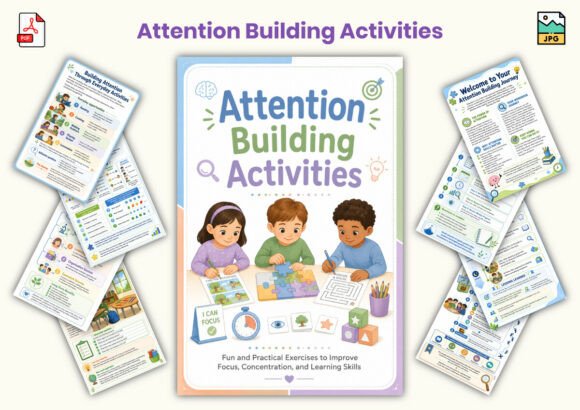
This workbook is not another stack of busywork. It is a 31-page collection of exercises, explanations, and reflection tools created with a child-friendly, therapy-inspired educational approach. The goal is straightforward: help children strengthen focus, concentration, observation, and learning skills in a way that feels engaging rather than punishing. And because it comes as both a PDF and high-quality JPG files, you can print pages as needed or use them digitally on a tablet or screen.
What Makes This Workbook Different
Many attention resources rely on generic worksheets that lack context or real-world connection. Children complete the task, but they never quite understand why it matters or how to apply those skills outside the page. This workbook avoids that trap by weaving together educational lessons, case examples, and action plans that give each activity purpose.
Several qualities stand out:
- Skill variety: Instead of focusing only on visual focus, the workbook includes listening exercises, pattern recognition tasks, problem-solving challenges, and observation drills. This breadth ensures that attention is treated as a multi-dimensional skill, not a single behavior.
- Real-life applications: Case examples and practical scenarios help children connect the exercises to everyday situations—following a classroom instruction, completing a chore, or staying engaged during a conversation.
- Built-in reflection and growth pages: Children are not just completing tasks; they are also encouraged to think about their own progress, identify strategies that work for them, and set goals. This meta-cognitive layer is often missing in traditional resources.
- Therapy-inspired design: The structure and pacing reflect how child therapists and educational specialists typically scaffold attention skills—starting with simpler tasks and gradually increasing complexity while providing support and encouragement along the way.
Who Benefits Most from Attention Building Activities
The workbook is marketed as ideal for teachers, homeschool families, child therapists, educational professionals, parents, and learning centers. That is a broad audience, but the material genuinely serves each group well because it is flexible enough to fit different settings.
Teachers and Classroom Educators
Managing a classroom of diverse learners means having tools that can be adapted on the fly. You can pull a single page for a morning warm-up, use a pattern recognition activity as a brain break, or assign reflection pages as part of a student’s individual learning plan. The print-ready format means no prep time—just print and use.
Homeschool Families
Homeschooling parents often juggle multiple subjects and age levels. Having a dedicated resource that builds focus skills without requiring extensive setup is valuable. You can integrate a page into your daily routine, use it as a focused activity before a challenging subject, or revisit the strategies pages when a child is struggling to stay on task.
Child Therapists and Educational Professionals
The therapy-inspired design makes this workbook a natural fit for one-on-one sessions, group interventions, or home program assignments. The action plan and reflection pages are particularly useful for tracking progress over time and helping children take ownership of their growth.
Parents at Home
Not every parent has training in child development, but every parent wants their child to succeed. The workbook includes tips and strategies for better focus, so you are not just handing over an activity—you are learning alongside your child about what helps them pay attention.
Practical Applications Across Different Environments
The true strength of Attention Building Activities lies in how easily it fits into real routines. Here are some practical ways it can be used:
- Morning focus warm-up: Start the day with a short observation or pattern recognition page to set a calm, attentive tone before lessons begin.
- Transition tool: When switching between subjects or activities, use a listening exercise or problem-solving puzzle to help children shift their mental gears.
- Individual intervention: For a child who struggles with sustained focus, assign one or two pages daily as part of a personalized plan, using the reflection pages to track what works.
- Group activity: In a classroom or therapy group, complete a case example together and discuss the strategies used. This normalizes attention challenges and builds a shared vocabulary around focus.
- Digital use: Because high-quality JPG files are included, you can upload pages to a tablet, use annotation tools, or share them in a virtual learning environment.
Benefits That Extend Beyond the Workbook
When children build stronger attention skills, the effects ripple outward. They are better able to follow instructions, complete assignments with fewer errors, participate in group discussions, and regulate their own impulses. For educators and parents, this means less time redirecting and more time teaching or connecting.
From a professional standpoint, the workbook also supports documentation and goal-setting. Therapists and learning specialists can reference specific pages when writing progress notes or designing home programs. Teachers can show concrete examples of skill-building during parent conferences. And homeschool families can demonstrate measurable growth in areas that often feel subjective.
Realistic Examples of How the Workbook Works in Practice
Imagine a second grader who consistently misses steps during multi-step instructions. A teacher might use the listening skill practice pages to break down auditory processing into manageable pieces. Over several sessions, the child practices following one-step, then two-step, then three-step directions. The action plan page helps the teacher and child decide together which strategies—like repeating the instruction aloud or visualizing each step—are most effective.
Or consider a therapy session with a child who has difficulty staying engaged during seated tasks. The therapist selects a pattern recognition activity that is visually interesting but requires sustained attention to complete. After the activity, they use the reflection page to discuss what helped the child persist and what felt distracting. Over time, these insights inform both the therapy plan and the child’s growing self-awareness.
For a homeschool parent with a distractible learner, the summary and review pages can be reused weekly. The child marks which strategies worked, which activities felt too easy or too hard, and what they want to try next. This turns the workbook into a living document that evolves with the child’s needs.
Practical Considerations When Using or Selecting Attention Resources
Not every resource is right for every child, and Attention Building Activities is no exception. The workbook is designed for children who can engage with structured activities for short periods—typically elementary age and older. Younger children may need more hands-on facilitation and shorter sessions, while older children or those with more advanced skills might move through pages quickly. The flexibility to print only what you need helps with pacing.
Because the workbook is delivered digitally, you will need either a printer or a device that supports PDF and JPG files. The 6×9 inch size makes pages easy to handle, store, or bind into a booklet. If you plan to use it digitally, test the file on your device to ensure the annotation tools you prefer are compatible.
For professionals managing multiple children, consider printing a class set of the most commonly used pages and storing them in labeled folders. This saves time and ensures consistency. For home use, involve the child in choosing which activities to do next—giving them a sense of ownership often increases engagement.
Final Thoughts on Building Attention Skills
Attention is not a fixed trait. It is a skill that can be taught, practiced, and strengthened—especially when the right tools are in place. The Attention Building Activities Workbook provides a structured yet flexible path forward, grounded in practical exercises and real-world application. Whether you are a teacher looking for classroom resources, a therapist designing interventions, a parent supporting your child at home, or a homeschool educator shaping your curriculum, this workbook offers a thoughtful, ready-to-use solution that respects both the science of attention and the reality of busy days.
The pages are designed to be used, reused, and adapted. The strategies are meant to stick. And the child—the one who needs to build these skills—gets a resource that treats their growth as a journey, not a checklist.