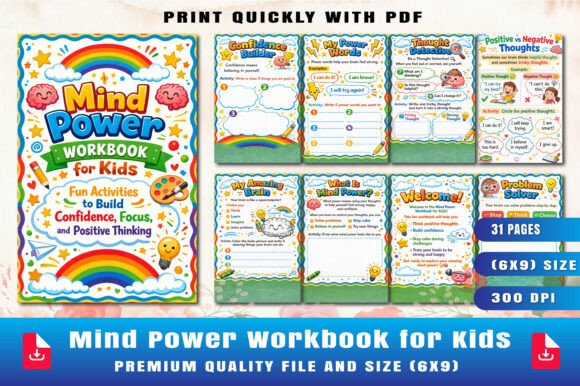
Mind Power Workbook for Kids
What It Really Means to Give Kids a Mental Toolkit
There is a moment every parent knows—when your child feels stuck. Maybe they are frustrated with homework, nervous before a test, or upset after a disagreement with a friend. You want to help them shift their thinking, but it is not always easy to find the right words. A resource like Mind Power Workbook for Kids can be that bridge between a feeling of helplessness and a moment of clarity. It is not just another activity book; it is a structured, playful way to introduce children to the idea that their thoughts are powerful tools.
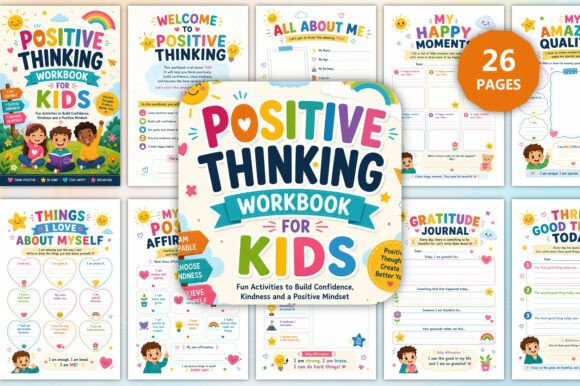
If you have ever watched a child struggle with self-doubt or anxiety, you know that telling them “just think positive” rarely works. This workbook takes a different approach—it invites kids to become detectives of their own minds, to experiment with calming breaths, and to build confidence through small, manageable tasks. The 31 pages are not overwhelming; they are designed to be used a little at a time, fitting naturally into a morning routine, a quiet afternoon, or even a car ride. The 6×9 inch size makes it easy to tuck into a bag, perfect for school pickup waits or rainy day activities.
Homeschool Parents and the Need for Social-Emotional Learning
Homeschooling is more than academics. Many parents who choose this path are deeply aware of the need to nurture emotional intelligence alongside reading and math. A workbook like this fills a gap that curriculum guides often overlook. When your child is struggling with perfectionism, or when they shut down after a mistake, the Mind Power Workbook for Kids offers activities that feel like play but serve a deeper purpose. The gratitude pages, for example, are not just about listing things to be thankful for—they ask kids to draw what gratitude looks like, or to imagine how kindness ripples out to others.
I have seen homeschool parents use these pages as morning warm-ups. The calm breathing exercises become a shared practice, something parent and child do together before a challenging lesson. The problem-solving prompts are not abstract; they mirror real life—like figuring out how to share a limited resource or what to do when a project feels too hard. The workbook does not lecture; it guides gently, with kid-friendly illustrations and open-ended questions that invite honest answers. For the parent who wants to raise resilient, thoughtful children without adding another heavy lesson plan to their day, this is a lightweight but powerful tool.
Classroom Teachers in Search of Social-Emotional Resources
Teachers in elementary classrooms feel the pressure to address emotional regulation and positive mindset, often without a dedicated curriculum. A resource like the Mind Power Workbook for Kids can be used in whole-group settings, small groups, or individual check-ins. Imagine a second-grade class where children have just returned from a high-energy recess. Instead of struggling to refocus, the teacher pulls out a page from the workbook—maybe the thought detective activity where kids identify “tricky thoughts” and replace them with helpful ones. The language is simple: “My thought detective name is… Today I caught a thought that was not true. I changed it to…”. No heavy jargon, just a child-friendly way to practice cognitive reframing.
Counselors in schools have also found value here. They can photocopy individual pages (the printable format supports this) or use the workbook as a take-home resource for students working on anxiety or self-image. The positive affirmation exercises are not saccharine; they are phrased in ways that feel authentic to a child, like “I can try again even if I feel scared” or “My brain grows when I learn something new.” For teachers with limited time, having ready-to-use activities that require no prep—just print or open the PDF—is a genuine time-saver.
Clinical and Play Therapy Settings
Therapists who work with children often look for tools that are engaging yet clinically sound. It can be hard to find a resource that respects the child’s developmental level while still addressing core skills like emotional regulation and resilience. The Mind Power Workbook for Kids provides a framework that a therapist can adapt. The “calm breathing” pages, for instance, use visual cues and simple instructions—like tracing a shape while breathing in and out—that align with common relaxation techniques. The reflection pages at the end allow a child to articulate what they have learned, giving the therapist insight into their inner world.
A therapist might use this workbook over several sessions, assigning a page as “homework” between appointments. The child feels ownership over the colorful pages, and the parent can support the process at home, reinforcing skills practiced during therapy. The workbook does not diagnose or treat, but it creates a shared language: “Let’s do some thought detective work,” or “Remember how we practiced calm breathing?” It becomes a bridge between the therapy room and daily life, which is often where real change happens.
Parents of Anxious or Highly Sensitive Children
If your child tends to worry, has trouble sleeping, or gets stuck in negative thought loops, you have probably tried many approaches—some that help, some that do not. The Mind Power Workbook for Kids can serve as a low-pressure way to introduce coping strategies. Because the activities are playful, children are less resistant. They might not want to talk about their feelings directly, but they will happily draw a picture of their “happy place” or list three things they are good at. The confidence-building prompts are especially useful for kids who compare themselves unfavorably to peers or siblings.
I have seen parents use the gratitude activities at bedtime, turning worry into a positive reflection. Instead of ruminating on what went wrong, the child fills in a simple prompt: “Something kind I did today… Something kind someone did for me…” It shifts focus without feeling forced. The workbook does not promise to eliminate anxiety overnight, but it gives a child a sense of agency. They learn that they can influence their own thoughts, and that is a powerful lesson for anyone at any age.
Strengths of the Workbook
- Age-appropriate design: The illustrations and language are crafted for elementary-aged children (roughly 5 to 12), avoiding both oversimplification and abstract concepts that may feel distant.
- Flexible format: Printable and digital-friendly means you can use it on a tablet, project it on a screen, or print individual pages as needed. No need to carry a physical workbook everywhere if that does not suit your lifestyle.
- Variety of activities: From drawing and coloring to writing prompts and breathing exercises, the workbook addresses different learning styles. Kinesthetic learners can trace patterns; verbal kids can answer questions; visual kids can create art.
- Low pressure, high engagement: The tone is encouraging, not corrective. Each page feels like a small adventure rather than a lesson, which reduces pushback from children who are wary of “work.”
- Practical life skills: The focus on gratitude, kindness, and problem-solving extends beyond the page. The skills transfer into how children interact with peers, family, and themselves.
Things to Consider Before Choosing This Workbook
No resource is perfect for every situation. The Mind Power Workbook for Kids is not a substitute for professional mental health support if a child is experiencing serious distress or trauma. It is a supplementary tool—a way to practice skills in a safe, creative environment. For children under five, some activities may be too advanced in terms of reading or writing; parents may need to adapt or use the pages as conversation starters. Similarly, older children (teens) might find the illustrations too childish; the workbook is best suited for the younger end of the age range.
The digital format requires printing or device use, which some families may find inconvenient. However, the ability to print repeatedly is a benefit for parents who want multiple children to use the same resource, or who want to reuse favorite activities. The workbook is designed for personal and educational use, not for commercial reproduction, so keep that in mind if you are a therapist or teacher planning to distribute copies widely.
How Different Users Get Creative with It
The true power of the workbook lies in its adaptability. A parent might use it as a weekend bonding activity, working through one page together and discussing it over snack time. A teacher might incorporate a page into a morning meeting or as a quiet activity after lunch. A counselor might pair the workbook with a feelings chart or a reward system. A homeschool co-op could use it as a group activity, having children share their “thought detective” findings or their gratitude drawings.
I have observed that the reflection pages at the end are often the most revealing. Children who are normally quiet may write or draw things they would never say out loud. That makes the workbook a valuable communication tool—it gives adults a window into a child’s inner life without demanding direct conversation. For children who love drawing, there are dedicated creativity pages. For those who love checklists, there are prompts that feel like puzzles. The workbook respects different personalities.
Final Observations on Building a Healthy Mindset
Helping a child develop positive thinking and confidence is not a one-time event—it is a practice. The Mind Power Workbook for Kids supports that practice in a way that feels natural, not clinical. It does not preach; it invites. It does not overwhelm; it breaks things down. Over time, a child who uses this workbook may begin to internalize the language of self-compassion and curiosity. They might start catching negative thoughts on their own, or pause to take a calm breath before reacting. Those are the quiet victories that make a real difference in a child’s life.
If you are looking for a resource that is both playful and purposeful, that you can reach for on ordinary days and tough days alike, this workbook is worth exploring. It is compact enough to try without a huge commitment, yet comprehensive enough to revisit many times. The skills it teaches—gratitude, focus, problem-solving, creativity—are not just for childhood; they are for life.