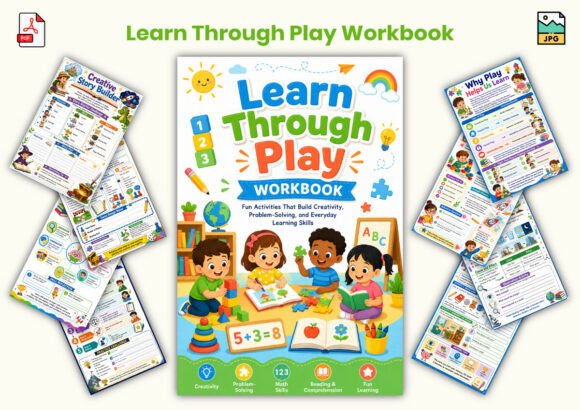
Learn Through Play Workbook
If you’ve ever watched a child lose track of time while building a fort, sorting colorful blocks, or drawing a map of an imaginary island, you already know the power of play. Learning sticks when it feels like fun. That’s the simple idea behind the Learn Through Play Workbook — a collection of 31 activity pages designed to help children develop essential skills without the drudgery of traditional worksheets. Whether you’re a parent looking for screen-free afternoon activities, a teacher seeking fresh classroom material, or a homeschooler carefully crafting a curriculum, this workbook fits seamlessly into real life.
The pages are print-ready, sized at 6 × 9 inches, and come in both high-resolution JPG and PDF formats. But the real value isn’t in the file format — it’s in what those pages do. Each activity nudges children toward creative thinking, observation, problem-solving, communication, and curiosity. The workbook is intentionally open-ended, so kids can explore without feeling like they’re being tested. That shift — from pressure to play — changes everything.
Where the Workbook Fits Into Real Life
Think about a typical Wednesday afternoon. School is out, but the energy hasn’t faded. You need something that engages young minds without a lot of setup or prep. The Learn Through Play Workbook becomes that bridge between structured learning and free time. You print a few pages, lay out some crayons or colored pencils, and suddenly the child is hunting for patterns in a maze, writing a journal entry from the perspective of a garden snail, or collaborating with a sibling on a treasure map challenge.
It’s not just for quiet time at home. Consider a tutoring session where a child struggles with focus. Instead of drilling facts, you pull out an observation exercise — something like “Find seven hidden objects in this garden scene.” The child’s brain shifts into detective mode. Memory and concentration practice feels like a game, not work. Over time, that approach builds confidence and resilience, especially for kids who resist traditional learning methods.
For homeschooling families, the workbook offers a flexible supplement. You can weave a creative thinking activity into a science lesson about nature or use a goal-setting page to wrap up a week of studies. Because the topics span curiosity and exploration, teamwork, reflection, and pattern recognition, it’s easy to match an activity to whatever skill you want to reinforce that day.
Parents Looking for Bonding Activities
You don’t have to be a teacher to use this workbook. Parents often find themselves asking, “How do I help my child learn without making them feel like I’m drilling them?” The Learn Through Play Workbook answers that by providing ready-made activities that invite conversation. Sit down together with a reflection page: “What was the best part of your day? Draw it and write three words to describe it.” That simple prompt opens a window into your child’s thoughts, strengthens communication, and practices writing — all while feeling like a shared ritual rather than homework.
Another real-world scenario: a long car ride or a rainy weekend. You don’t want to hand over a tablet. Print a few pages and tuck them into a travel binder. The problem-solving challenges and pattern exercises keep kids occupied and engaged without a screen. The workbook becomes a go-to resource for those moments when you need a peaceful, productive activity at hand.
Teachers in Classroom and After-School Settings
Classroom time is precious, and teachers need resources that work for diverse learners. The Learn Through Play Workbook supports independent learning — kids can follow the activity prompts with minimal adult guidance. During a lesson on teamwork, you could use the teamwork and communication tasks in small groups: children pair up to solve a maze where each partner controls a different path, or they plan a pretend community event together. These exercises naturally spark collaboration without requiring elaborate preparation.
For after-school programs or day camps, the workbook serves as a flexible backbone. The pages don’t assume prior knowledge, so you can mix and match across age groups. A six-year-old might enjoy the observation and discovery exercises, while a nine-year-old can tackle the goal-setting and planning activities. The child-friendly layouts and professional design mean each page looks inviting, not intimidating — important when you’re managing a room full of varying attention spans.
Homeschoolers Building a Well-Rounded Curriculum
Homeschooling often means weaving together different resources. The Learn Through Play Workbook fits that mosaic perfectly. It’s not a complete curriculum, but it fills gaps that textbooks miss: curiosity and exploration, creative expression, and practical life skills like planning and reflection. Many homeschooling parents use the workbook as a warm-up activity each morning. A quick pattern recognition exercise gets the brain in gear for math, while a “learning through play challenge” — something like “Design a game using only three objects in your room” — becomes the foundation for a whole afternoon project.
Because the workbook includes reflection and journal pages, it also supports emotional development. A child can write or draw about a challenge they faced during the day, what they learned, and how they felt. That habit of self-awareness and goal setting is hard to teach with traditional worksheets alone. The workbook hands it to you in a format kids actually want to complete.
Tutors Targeting Specific Skills
Tutors often work one-on-one with children who need extra support in areas like attention, memory, or problem-solving. The Learn Through Play Workbook gives you diverse material to target those skills without making the child feel “different.” For example, if you’re helping a student with short-term memory, you might use a concentration exercise that asks them to observe a detailed illustration for 30 seconds, then recall specific details from memory. If the student struggles with social skills or teamwork, you can role-play one of the communication tasks together.
The beauty for tutors is versatility: you can tear out individual pages, copy them, or keep a digital library. The print-ready interior means you’re not stuck with paper jams or formatting issues. And because the content is activity-based, sessions feel dynamic. You’re not repeating the same drill week after week — you’re building a toolkit of playful challenges that grow with the student.
Educational Creators and Content Developers
If you create learning resources — whether for Teachers Pay Teachers, a personal blog, or a subscription box — the Learn Through Play Workbook can be a springboard. It’s KDP and educational project friendly. The high-quality PDF and JPG files are ready for you to use as inspiration, as part of a larger bundle, or even as a starting point for your own activity designs. Many creators appreciate the professional layout and child-friendly aesthetics because those pages demonstrate how to balance visual appeal with educational rigor.
You could pull individual activities for a “printable of the week” feature or combine several worksheets into a themed unit on creativity and exploration. The workbook gives you a reliable structure — 31 unique pages covering core learning topics — so you can see what resonates with your audience before investing time in creating original content from scratch.
What to Consider Before Using the Workbook
No resource is perfect for every situation, so it helps to think about a few things before diving in. The Learn Through Play Workbook is designed for children who can follow simple instructions — roughly ages 4 to 9, though older children may still enjoy many of the creative and reflection tasks. If you’re working with a very young child (under 4), you’ll likely need to sit with them and adapt the tasks verbally. The pages are text-light for early readers but still assume some basic command of letters and numbers.
The workbook is also not a full curriculum. It excels as a supplement — something to spark curiosity, reinforce skills, or fill gaps. If you need systematic lesson plans, scope and sequence, or subject-specific drills, you’ll want to pair it with other materials. What the workbook does beautifully is build the mindset of learning through play: the willingness to try, to observe, to collaborate, to reflect. That’s a different kind of learning, but one that underpins all others.
Another consideration is the format. You receive a digital file to print at home or at a copy shop. That gives you flexibility — you can print individual pages as needed, reuse favorite activities, or bind the whole set into a booklet. However, if you don’t have easy access to a printer, the digital format may feel less convenient. Some users laminate pages for reuse with dry-erase markers, which extends the workbook’s life significantly. Others simply print once and work through the pages as consumables.
Practical Tips for Getting the Most Out of It
- Rotate activities — Don’t feel pressured to use all 31 pages in order. Let the child pick based on mood or energy level. One day may call for a calm reflection page; another calls for a fast-paced puzzle challenge.
- Combine with objects — Several activities encourage curiosity and exploration. Bring in real objects when possible (leaves, buttons, building blocks) to make the connection between the page and the world concrete.
- Embrace team play — Even if the workbook seems designed for one child, many teamwork and communication tasks work better with siblings or classmates. Use them as a chance to practice listening and negotiation.
- Track progress casually — The journal and goal-setting pages give children a sense of accomplishment. Let them look back at earlier pages to see how their thinking or drawing has changed over time. That reflection is a quiet teacher.
- Skip what doesn’t click — Every child has different preferences. If a page feels frustrating, set it aside. The workbook’s strength is its variety; there’s always another activity around the corner that will spark excitement.
The Learn Through Play Workbook isn’t a magic solution — it’s a tool that works when it meets the right moment, the right child, and the right adult who believes that play is serious learning. Whether you’re calming a restless afternoon at home, adding dimension to a lesson plan, or building your own resource library, the pages invite curiosity, creativity, and connection. And in a world full of screens and schedules, that kind of quiet engagement feels like a small triumph.