Burnout Recovery Journal: Rest, Reset, and Rebuild Your Energy With Purpose
Fatigue that lingers, a sense of detachment from work or life, and the feeling that even small tasks require enormous effort—these are common signs of burnout. Many resources promise quick fixes, but structured, thoughtful tools are harder to find. The Burnout Recovery Journal positions itself as exactly that: a guided space to slow down, reflect, and rebuild energy without the pressure of productivity. It is not a planner designed to optimize output. It is a recovery tool, and that distinction matters for anyone navigating stress, exhaustion, or emotional depletion.
This journal is built around the idea that sustainable recovery requires awareness, not force. It offers prompts, self-assessments, and planning pages that encourage users to identify stress triggers, restore balance, and gradually build healthier routines. The language throughout is gentle but not vague, and the structure provides enough guidance without feeling prescriptive. For professionals, entrepreneurs, freelancers, and anyone in a demanding role, this kind of resource can serve as a practical anchor during periods of overwhelm.
What Makes the Burnout Recovery Journal Distinct
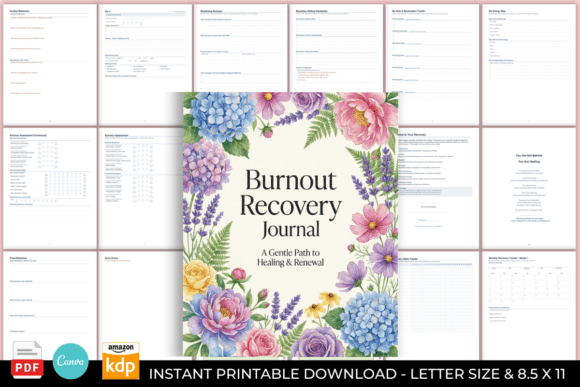
The journal is divided into several core sections, each serving a specific function in the recovery process. Rather than a single logbook or diary, it functions more like a modular system that adapts to different stages of burnout recovery.
Burnout Self-Assessment
Understanding where you stand is the first step. The journal includes energy level check-ins, stress trigger identification exercises, emotional awareness prompts, and work-life balance reflection pages. These are not clinical diagnostic tools, but they are useful for building a clearer picture of what is draining you and why. For someone who has been running on autopilot, this section can provide a much-needed pause.
Recovery Planning
This section addresses the practical side of recovery. It includes a personal reset plan, boundary-setting exercises, self-care planning worksheets, and an energy management tracker. The emphasis is on realistic adjustments rather than aspirational overhauls. This matters because burnout often follows periods of excessive self-demand. A journal that asks you to set gentle boundaries rather than reinvent your life overnight is likely to be more effective in practice.
Daily and Weekly Reflection Pages
Consistent reflection is a pillar of recovery, and this journal supports it with mood tracking, gratitude prompts, and space to record small wins. It also includes two particularly useful prompts: What drained me and What restored me. Over time, tracking these two variables can reveal patterns that would otherwise remain invisible. The daily and weekly pages are designed to be quick to fill out, which reduces the risk of abandoning the journal when energy is low.
Gentle Goal Setting
Goal setting during burnout recovery is different from typical goal setting. This section focuses on realistic priority planning rather than ambitious targets. It encourages users to identify one or two meaningful actions per day or week, which helps rebuild momentum without triggering further stress.
Quality, Usability, and Real-World Performance
Evaluating a journal like this requires looking beyond content to structure and design. The layout is described as non-overwhelming, and that is a key strength. Pages are clearly separated by function, and prompts are spaced in a way that avoids visual clutter. For someone experiencing cognitive fatigue or brain fog—common during burnout—this matters considerably. A dense or poorly organized journal would likely be abandoned.
The prompts strike a balance between being specific enough to be useful and open enough to allow personal interpretation. For example, the emotional awareness prompts do not assume a clinical vocabulary; they use everyday language that most adults can engage with immediately. This makes the journal accessible to a wide audience, including those who have never used a structured recovery tool before.
Durability and physical quality are also relevant for a product meant to be used over weeks or months. While specifics about paper quality and binding have not been detailed here, the intended use suggests that a sturdy, lay-flat binding and thick enough paper to handle pen without bleed-through would be important. Users should evaluate these factors when selecting a version.
In real-world use, this journal is likely to perform best for people who are ready to engage in reflective work but need a framework to do so. It is not a substitute for therapy or medical intervention, but it can complement professional support or serve as a starting point for deeper self-inquiry. The emphasis on sustainable growth rather than immediate results aligns well with the gradual nature of real recovery.
Who Benefits Most From This Journal
The Burnout Recovery Journal is suited to a broad range of adults aged 20 to 50 who are experiencing burnout or prolonged stress. However, certain groups may find it particularly valuable based on the structure and focus of the content.
- Professionals in high-demand roles: Marketers, educators, managers, and healthcare workers often face sustained pressure with little room for reflection. This journal provides a structured way to step back without feeling like you are falling behind.
- Entrepreneurs and small business owners: The pressure to constantly perform and make decisions can lead to exhaustion. The boundary-setting and priority-planning sections are directly relevant to anyone whose work bleeds into personal time.
- Freelancers and creators: Irregular workloads, financial uncertainty, and the lack of separation between work and life are common stressors. The self-assessment and energy tracking features can help identify patterns that contribute to burnout.
- Students and academics: Academic pressure, especially at the graduate or postgraduate level, can be intense. The gentle goal-setting approach is particularly useful for those who need to maintain progress without adding to their stress load.
- Serious hobbyists and volunteers: Passion projects and unpaid commitments can also lead to burnout. The journal's focus on awareness and balance applies regardless of whether the stress is professional or personal.
Strengths and Practical Value
One of the journal's strongest features is its refusal to treat recovery as a linear or simple process. The prompts allow for setbacks, low-energy days, and uncertainty. This honesty is rare in self-improvement tools, which often imply that consistent effort leads to consistent progress. The journal acknowledges that some days will be about surviving, and that is acceptable.
The What restored me prompt is particularly effective. It shifts attention away from problems and toward small sources of relief or joy. Over time, completing this prompt builds a personal catalog of strategies that work, which can be referenced during difficult periods.
Another practical strength is the integration of daily and weekly perspectives. Daily tracking captures granular patterns, while weekly reflection provides a broader view. This dual approach helps users avoid overreacting to single bad days while still catching meaningful trends.
The journal also avoids overcomplicating self-care. Self-care planning worksheets are included, but they are framed as realistic actions rather than elaborate rituals. This reduces the likelihood of turning self-care into another source of pressure.
Limitations and Considerations
No resource is universally effective, and the Burnout Recovery Journal has limitations worth noting. For someone in acute distress or experiencing clinical depression or anxiety, a guided journal may not be sufficient. Professional support should be prioritized in such cases.
The journal assumes a certain level of literacy and comfort with self-reflection. Individuals who prefer more directive or action-oriented approaches may find the open-ended prompts frustrating. Similarly, those who are not ready to confront underlying emotions may find the emotional awareness exercises confronting.
There is also the question of long-term engagement. The journal is designed for periods of active recovery, but maintaining the habit of daily entries can be challenging when motivation is low. Users may need to commit to a simplified version of the process—such as completing only the weekly reflection pages—to stay consistent.
Finally, the journal's effectiveness depends on honest engagement. It is possible to fill in pages without genuine reflection, but doing so would undermine the purpose. Users who approach the journal with openness and a willingness to sit with discomfort are most likely to benefit.
Practical Recommendations for Use
To get the most out of the Burnout Recovery Journal, approach it as a tool for awareness rather than a task list. Start with the burnout self-assessment, but do not feel pressured to complete every section immediately. Focus on the prompts that feel most relevant to your current situation.
Consider pairing the journal with a simple routine: five to ten minutes in the morning or evening, without distractions. Consistency matters more than duration. On low-energy days, even a single sentence about what restored you can be valuable.
Use the weekly reflection pages to look for patterns rather than to critique yourself. Notice which drains recur and which restorations appear most often. This information is practical feedback, not a judgment.
If you find the daily prompts too demanding, adapt the process. Focus on the weekly pages and the recovery planning sections. The journal is a resource meant to serve you, not the other way around.
Final Assessment
The Burnout Recovery Journal offers a thoughtful, structured approach to recovery that prioritizes awareness, patience, and realistic change. It is not a quick fix, and it does not pretend to be. For adults in demanding roles who are ready to slow down and reflect, it provides a useful framework that respects the complexity of burnout. When used with consistency and honesty, it can help clarify what needs to shift—and support the gradual process of rebuilding energy on your own terms.