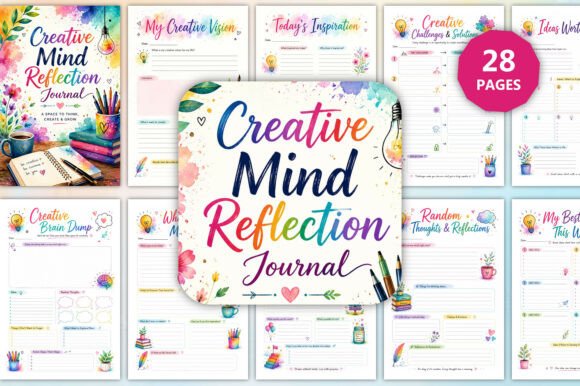
Creative Mind Reflection Journal
Most creative professionals know the frustration of having too many ideas and not enough clarity. You sit down to work, and instead of focusing, you bounce between half-formed concepts, unfinished projects, and the nagging feeling that something valuable is slipping through the cracks. The Creative Mind Reflection Journal was built to solve that exact problem. It does not promise to turn you into a genius overnight. What it does offer is a structured, practical system for capturing what matters, releasing what does not, and building a creative practice that actually sticks.
At its core, this journal is a self-reflection and creativity workbook. But calling it just a workbook undersells what it does. It combines mindfulness exercises, goal-setting frameworks, gratitude prompts, and emotional awareness check-ins with dedicated space for idea generation and creative problem-solving. The result is a tool that feels both expansive and grounded. You can use it to plan your next project, untangle a difficult emotion, or simply remind yourself why you started making things in the first place.
What Makes This Journal Different
Many journals focus on one thing. Productivity journals track tasks. Gratitude journals record positive moments. Art journals emphasize visual expression. The Creative Mind Reflection Journal pulls these threads together into a single, cohesive system. It does not ask you to choose between being productive and being reflective. It assumes you need both.
The journal is organized around five core areas that I have found directly useful in my own work as a writer and designer. Each section serves a distinct purpose, and together they form a loop: you discover your direction, capture your ideas, clear your mental clutter, reflect on your daily experiences, and then refine your vision again. That cycle is what makes the journal feel like a complete personal development system rather than just a notebook with pretty prompts.
Creative Vision Self-Discovery
Before you can create consistently, you need a sense of where you are heading. The journal opens with guided prompts like My Creative Vision and What I want to create. These are not abstract questions. They force you to articulate your direction in concrete terms. When I first worked through this section, I realized my goals were scattered across half a dozen unrelated projects. Naming what I actually wanted to build helped me drop the projects that were draining my energy without moving me forward.
For a designer, this might mean defining the visual language you want to explore this year. For a blogger, it could mean identifying the core topics your audience needs most. For an entrepreneur, it might mean clarifying the emotional experience you want your customers to have. The prompts are open enough to adapt but specific enough to generate real answers.
Ideas Inspiration Pages
Ideas are fragile. They show up at inconvenient times and vanish just as quickly. The journal includes structured sections for Ideas worth exploring, My best ideas this week, Things I want to create, and Creative challenges solutions. These pages give your ideas a home where they can grow instead of evaporating.
I keep my journal open on my desk during the workday. When a random thought surfaces about a project I am not even working on, I drop it into the ideas section. Later, during my weekly review, I revisit those notes. Some go nowhere. Others spark something I would have forgotten entirely. The act of capturing alone is valuable, but the real payoff comes from returning to those ideas with fresh eyes.
Brain Dump and Mind Clarity
The Creative Brain Dump pages are exactly what they sound like: unguarded space for whatever is occupying your mental bandwidth. This can be work stress, personal worries, random observations, or fragments of ideas that are not ready for the structured sections yet. The goal is not to organize. The goal is to release.
I have found that doing a five-minute brain dump before starting a focused creative session clears the resistance that often blocks flow. It is like defragmenting a hard drive. Once the clutter is on paper, your mind is free to focus on the task in front of you.
Daily Inspiration and Reflection
The guided daily prompts ask three simple questions: What inspired you today? How did it make you feel? What lessons did you learn? These questions are deceptively powerful. Over time, they train your brain to notice inspiration more readily. You start looking for the small moments that might otherwise pass unnoticed. A color combination on a subway poster. A line of dialogue in a conversation. The way light falls across your desk at a certain hour.
The reflection also includes space for Actions. This is critical because inspiration without action becomes passive consumption. The journal asks you to convert what you noticed into something you can do. It does not have to be big. A single small action each day compounds into meaningful progress over weeks and months.
How Different Creatives Can Use This System
The Creative Mind Reflection Journal is designed for flexibility. Its structure works across disciplines because the underlying needs—clarity, capture, release, reflection, action—are universal. But different users will naturally emphasize different sections depending on their context.
Writers and Bloggers
If you write for a living or as a serious hobby, the ideas section becomes your editorial pipeline. Use Ideas worth exploring to log topics before they fully form. When you sit down to write, scan that list for something that resonates. The daily reflection prompts can also serve as raw material for personal essays or newsletter content. I have published at least four articles that started as daily responses in my journal.
The vision section helps you define your editorial direction. Rather than chasing trending topics, you can align your writing with the themes that matter most to you and your audience. That consistency builds trust and keeps your content from feeling scattered.
Designers and Visual Creators
For designers, the journal is a place to log visual inspiration without the pressure to produce polished output. Use the brain dump pages to sketch rough layout ideas, color experiments, or typography combinations. The creative challenges section is ideal for working through design problems that feel stuck. Describe the constraint, list possible solutions, then step back and evaluate.
The reflection prompts also help designers stay connected to their emotional responses. Design is about how things feel as much as how they look. Noticing how certain visuals affect you trains your sensitivity, which directly improves your work.
Entrepreneurs and Small Business Owners
Running a business demands constant creative problem-solving. The journal gives you a structured space to think through strategy, customer experience, and product ideas without the noise of spreadsheets and dashboards. Use the vision section to revisit your business purpose. Use the ideas pages to capture potential features, marketing angles, or partnership opportunities.
The weekly review habit that the journal encourages is especially valuable for entrepreneurs. It creates a regular pause where you can assess what is working and what is not. That reflection prevents you from pouring energy into activities that do not move the business forward.
Educators and Hobbyists
Teachers can use the journal to plan creative lessons, reflect on what resonated with students, and generate new approaches to familiar material. Hobbyists benefit from the structure because it turns a casual interest into a deliberate practice. If you paint on weekends, the journal can help you track your growth, experiment with new techniques, and stay motivated when progress feels slow.
Practical Ways to Integrate Reflection Into Your Creative Workflow
Owning the journal is not enough. The real value comes from building a rhythm around it. Here are three approaches I have tested and recommend.
- Morning anchor: Spend ten minutes with the daily reflection prompts before you check email or social media. This sets your creative intention for the day and protects your mental space from reactive thinking.
- Weekly review: Set aside thirty minutes each Sunday to revisit the ideas you captured, assess your progress on goals, and plan the week ahead. This turns scattered notes into actionable priorities.
- Creative sprint: Use the journal to structure a focused creative session. Start with a brain dump, then move to the challenges section to define the problem, then use the ideas pages to generate solutions, and finish with the reflection prompts to capture what you learned.
Each of these approaches can be adapted to your schedule. What matters is consistency. Even five minutes a day produces better results than an hour once a month.
Keeping Your Practice Clear and Effective
A journal system only works if it does not become another source of pressure. I have seen people abandon journals because they felt they had to write something profound every time. That expectation kills the very spontaneity the journal is meant to protect.
Give yourself permission to write badly. Use bullet points instead of sentences. Leave pages blank if nothing comes. Treat the journal as a tool for thinking, not a performance space. Over time, the practice itself will teach you what works for your mind and your creative process. The Creative Mind Reflection Journal provides the structure. You provide the honesty.
The most useful creative tool is not the one with the most features. It is the one you actually use. This journal earns its place on your desk because it asks for less than you expect and gives back more than you anticipate. It is a space to discover what you think, what you want, and what you are capable of building. And that kind of clarity is something every creator needs.