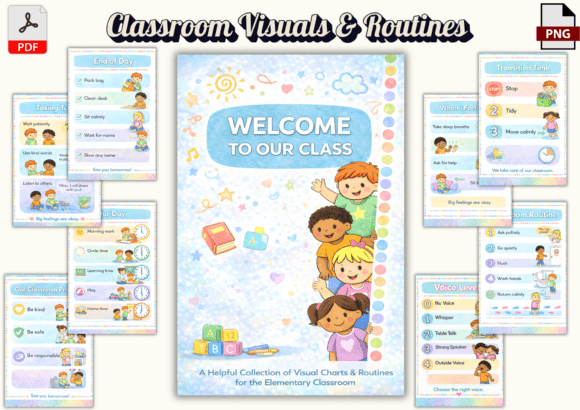
Create Calm Classrooms with Classroom Visuals Routines
For anyone who works with young children, the difference between a chaotic day and a smooth one often comes down to one thing: clear expectations. Young learners thrive when they know what comes next and what is expected of them. Classroom Visuals Routines offers a practical, ready-to-use set of visual prompts that help children navigate their day with confidence. This resource includes 17 pages of illustrated routine cards, voice level charts, calm-down strategies, sharing and turn-taking visuals, classroom promises, and full-day schedule cards. Designed for PreK through Year 1, it supports both print and digital use, making it flexible for whiteboards, slides, posters, or individual student reference sheets.
The core idea is simple: replace verbal reminders with consistent, child-friendly images that children can reference independently. This approach reduces the cognitive load on both the teacher and the student. Instead of repeating instructions, you point to a visual. Instead of guessing what to do next, a child checks the routine card. Over time, these visuals become part of the classroom environment, building a sense of safety, predictability, and ownership.
Why Visual Routines Matter Across Different Teaching Contexts
The value of visual routines extends beyond any single classroom type. Whether you are a seasoned early childhood educator, a first-year teacher building your management toolkit, a homeschooling parent, or a specialist working with children who need extra support, this resource addresses a common challenge: helping children move through daily transitions with less stress and more self-reliance.
For beginners—those new to teaching or managing a group of young children—visual routines act as a safety net. When you are still learning the rhythm of the day, having a preset set of clear expectations means you do not have to invent every procedure from scratch. You can focus on building relationships and responding to individual needs rather than constantly redirecting behavior. The voice levels chart alone can save hours of repeated shushing and reminders. A beginner can print the pages, place them at eye level, and introduce one routine at a time without feeling overwhelmed by fancy formatting or complicated behavior systems.
Experienced educators often look for resources that integrate easily into existing systems. You may already have a morning routine or a cleanup song. What Classroom Visuals Routines offers is consistency across different parts of the day and across different staff members. If you have teaching assistants, substitute teachers, or volunteer helpers, these visuals create a common language. Everyone points to the same quiet voice picture. Everyone references the same calm-down choices. This alignment reduces confusion for children and makes your classroom environment predictable even when the adult in the room changes. Experienced users will appreciate that the digital format lets them project the routine cards onto a whiteboard during morning meeting, then print smaller versions for individual desk references or take-home folders.
Using the Resource for Social-Emotional Learning and Regulation
Social-emotional learning is not a separate subject in early childhood—it happens during every transition, every conflict over a toy, and every moment a child feels frustrated. This resource includes specific calm-down strategies and turn-taking visuals that directly address these moments. For a child who is learning to manage big feelings, having a visual choice board of calming options—such as deep breathing, squeezing a stuffed animal, or taking a break in a cozy corner—provides a concrete path toward self-regulation rather than relying on punishment or time-out.
Educators working with children who have developmental delays, language barriers, or attention differences will find particular value in the clear, uncluttered illustrations. The pictures use simple language and child-friendly imagery without overwhelming detail. A child who does not yet understand spoken instructions can follow along by looking at the image of sitting crisscross on the rug or raising a hand to ask for help. For speech-language pathologists or early intervention specialists, these visuals can serve as a bridge between adult expectations and a child's ability to communicate their needs. The help-seeking routine card encourages children to try a strategy on their own before asking an adult, which builds problem-solving skills in a gentle, structured way.
Practical Applications for Different Learning Environments
The flexibility of both print and digital formats means you can adapt this resource to your specific setting. In a traditional classroom, you might print the full-day visual schedule on cardstock, laminate it, and display it prominently near the carpet area. Each morning, you can move a marker to show where you are in the day. Children learn to check the schedule independently, reducing the constant stream of "is it snack time yet?" For teachers using centers or stations, the clean-up and transition routines help children understand the flow from one activity to the next without chaos. A simple visual showing "clean up your space, wash your hands, sit on the rug" becomes a reliable sequence that children can follow without verbal guidance every time.
Homeschooling parents or family child care providers may use these visuals in a smaller setting. The routines work just as well for a group of three children as they do for twenty. You can print the pages at a smaller scale, create a mini schedule board, or slide them into a binder that your child flips through each morning. The end-of-day routine card helps young children know exactly what to do before pickup—pack their bag, put on their jacket, say goodbye—which turns a potentially rushed and stressful time into a smooth wind-down. For parents who are also working from home, these visuals can support independent play and transition times, giving you a few minutes to focus on a task without constant interruptions.
What to Look for When Choosing a Visual Routines Resource
Not all visual routine sets are created equal. Before selecting one, consider what matters most for your situation. Quality of illustrations matters because children will be looking at these images repeatedly. The graphics in this set are eye-catching without being busy, and they represent diverse children and inclusive scenarios, which helps every child see themselves in the routines. Clarity of language is important for young learners and for adults who may not be familiar with your classroom jargon. The phrases used here are simple and positive: "We use walking feet," "We raise our hand to share," "We take turns." There is no focus on punishment or what not to do, which aligns with current best practices in early childhood education and SEL.
Flexibility of formats is another key consideration. The included PDF and PNG files mean you can print them at exact sizes for posters, insert them into slides, or resize them for individual cards. The 6 × 9 inch vertical format works well for standard paper sizes and for digital screens without distortion. If you plan to share visuals with families for home use, the PNG format allows easy upload to a private class app or website. The professional front cover and back cover blurb also make this set suitable for presenting to administrators or sharing with colleagues as a school-wide resource.
Durability and long-term usefulness matter for budget-conscious educators and programs. Printed and laminated, these cards can last for years. The digital files can be accessed from any device, so you will not lose them if a physical copy gets damaged. For teachers who switch grade levels or classrooms, the routines are general enough to apply across different early childhood settings while being specific enough to feel purposeful. You are not getting generic clipart—you are getting a curated set of procedures that reflect real classroom needs: bathroom breaks, chair and rug expectations, sharing, and cleanup.
Identifying Whether This Resource Matches Your Needs
If you work with children aged roughly four to seven years old and you want to reduce the number of times you repeat yourself each day, this resource will likely serve you well. It is especially useful if you are looking for a ready-made solution rather than designing visuals from scratch. The time saved in not having to create, test, and revise your own routine cards is significant. For a busy classroom teacher who has limited planning time, opening a set of 17 professionally designed pages and printing them immediately means you can implement the system tomorrow morning, not next month.
If your biggest challenge is helping children transition between activities without meltdowns, focus first on the transition routines and the visual schedule. Introduce them one at a time rather than all at once. For practitioners who coach or mentor other teachers, this resource can serve as a conversation starter about classroom management strategies. You can use the digital version during professional development sessions to model how to introduce a routine, then give participants the files as a takeaway they can immediately use.
For small business owners who run early childhood centers or after-school programs, having a consistent visual system across all classrooms creates a unified culture. When every room uses the same voice level chart and the same cleanup sequence, children move between spaces with less confusion, and staff training becomes more efficient. The commercial value lies in the time saved on training and the increased satisfaction of families who see a calm, organized environment.
On the other hand, if you are looking for a highly specialized routine set for a unique setting—such as an outdoor nature school or a multilingual program with very specific language needs—you might want to supplement these visuals with a few custom cards. The base set covers universal early childhood routines, but you know your context best. Fortunately, the simple illustration style and clear design make it easy to create matching additional cards if needed.
Building Independence and Reducing Stress Through Predictability
The ultimate goal of any classroom management resource is to create an environment where children feel safe enough to learn and explore. When children know what is expected, they do not have to guess or test boundaries as frequently. This lowers stress for everyone—children and adults alike. Classroom Visuals Routines supports that goal by putting the information where children can see it, in a format they can understand, using language that encourages rather than scolds.
As you introduce each visual, explain it in a positive tone. "This picture shows us what to do when we are done with our work. Let's look at it together." Over time, you will notice children pointing to the chart before asking you a question. You will see a child take a deep breath because they remember the calm-down card. You will hear a child remind a friend to use a quiet voice because the voice level chart is right there. That is independence in action, and it is exactly what this resource is designed to nurture.
The 17 pages in this set cover the key moments that often cause the most friction in a young child's day: entering the classroom, asking for help, waiting for a turn, cleaning up, and leaving at the end of the day. By addressing these moments with clear, positive visuals, you shift the focus from managing behavior to teaching skills. And that is a shift that benefits every learner, every educator, and every family involved.