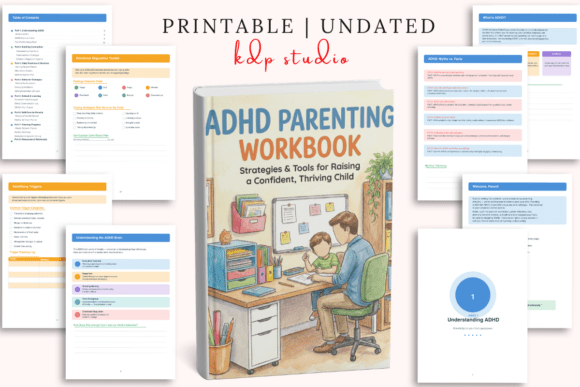
ADHD Parenting Workbook: Practical Tools for Calmer Homes
Parenting a child with ADHD often feels like trying to build a plane while flying it. You need real-world solutions, not generic advice. That’s where a well-designed ADHD Parenting Workbook becomes indispensable. It’s not just a collection of worksheets—it’s a structured environment for reflection, planning, and skill-building. Whether you’re a therapist adapting these materials for clients, a blogger creating your own version, or a parent seeking clarity, this workbook approach offers a flexible framework that meets you where you are.
Beyond Behavior Charts: Rethinking the Workbook’s Purpose
Most parenting resources focus on controlling symptoms. This workbook flips the script by emphasizing coaching over control. The goal is to help your child understand their own brain—its strengths and its challenges—while building predictable routines that reduce family friction. Instead of a one-size-fits-all sticker chart, the workbook guides you to co-create systems that actually stick.
For example, a morning routine planner isn’t just a list of tasks. It’s a collaborative tool where you map out each step visually, using language your child can internalize. “First we find socks, then we make a game of brushing teeth.” The workbook becomes a communication bridge, turning abstract executive function skills into daily habits.
Strengths-First Framing
ADHD brains are wired for creativity, quick thinking, and high energy when engaged. A strong workbook begins with a myth vs. fact section that normalizes these traits. It might include a “strengths inventory” where you and your child note what they love—building Lego towers, telling stories, solving puzzles. This shifts the narrative from “fixing a problem” to “building a life around strengths.”
For creators designing their own workbook, this is the emotional anchor. Every exercise should reinforce the message: different wiring isn’t broken. Parents need that reassurance as much as the strategies.
Who Can Use an ADHD Parenting Workbook (and How)
The audience is broader than just biological parents. Teachers, therapists, homeschoolers, and even older siblings managing care can adapt these materials. Here are specific ways different users might customize the workbook:
- Educators and school counselors can pull the “homework planning pages” and “focus strategies checklist” for IEP meetings or after-school tutoring sessions. The language is parent-friendly but translates easily into classroom accommodations.
- Bloggers and content creators can repurpose the structure into a digital course or a series of printable guides. For example, the “calm-down toolkit builder” could become a standalone mini-workbook for emotional regulation.
- Therapists use the “meltdown debrief sheet” to help families analyze triggers without blame. That pattern tracker becomes a clinical tool for identifying environmental or sensory factors.
- Entrepreneurs and small business owners designing a product line can study the workbook’s modular sections—morning, school, bedtime, behavior—to create targeted journals or planners for niche audiences.
The beauty is in the mix-and-match: not every family needs every section. A single mom working two jobs might only have energy for the “parent self-care” pages and the “weekly recharge planner.” That’s valid. The workbook respects real time constraints.
Core Sections That Make a Difference
While no two workbook designs are identical, certain sections consistently deliver value. Understanding why they work helps you use them more intentionally—or design your own with confidence.
Understanding ADHD
A child-friendly explanation of ADHD avoids jargon. It uses metaphors like “your brain has a super-fast race car engine, but the brakes are still being built.” This section also includes common challenges by age group: impulsivity in young kids, forgetfulness in tweens, time blindness in teens. By breaking it down, parents stop comparing their child to neurotypical peers.
Parenting Mindset Reset
This is the most overlooked but critical part. “Emotional regulation for parents” prompts you to notice your own triggers. A simple worksheet asks: What situations make you snap? What’s your go-to reaction? The goal is to move from reacting to responding. You learn to say, “I see you’re dysregulated. Let’s pause together.” That shift changes everything.
Self-compassion exercises are not fluff. They might be a prompt to write three things you did well that week—even if dinner was late. Parents of children with ADHD often feel blamed; this counteracts that by building resilience.
Daily Structure That Adapts
Routines need to be flexible, not rigid. A morning routine planner offers space for two versions: a smooth day version and a “when everything falls apart” version. The after-school reset routine includes physical movement (trampoline, bike ride) before homework. Visual schedules use icons for non-readers and older children alike.
One practical idea: laminate the “bedtime wind-down checklist” and let the child check off steps with a dry-erase marker. It turns routine into a game of ownership. Parents report this reduces bedtime battles by half.
Behavior and Emotional Skills
Positive reinforcement systems here aren’t about bribing. They’re about building intrinsic motivation. A “wins progress log” celebrates small victories—like remembering a backpack without reminders—while the “consequence planning worksheet” focuses on natural outcomes, not punishments. For instance, if a child refuses to do homework, the consequence might be that they use weekend free time to finish it, not arbitrary screen time removal.
Emotional vocabulary charts teach kids to name feelings beyond “mad” or “sad.” Words like overwhelmed, excited, frustrated, disappointed give them a handle on experience. You can use these charts during calm moments, not meltdowns.
Adapting the Workbook for Different Formats and Audiences
If you’re creating or publishing your own workbook, consider how digital (printable PDF) and physical versions serve different needs. A printable PDF allows parents to reuse pages (e.g., weekly planners). A bound workbook feels permanent and special—something to keep as a record of growth.
For a digital course, you might break the workbook into separate modules: Module 1: Mindset, Module 2: Routines, etc. Each comes with a short video explaining a worksheet. For social media, you can post one “trigger awareness” prompt as a carousel and direct followers to the full workbook.
Another variation: a family-friendly workbook designed to be used with the child sitting next to you. Some pages have space for child drawings (e.g., “Draw your calm-down place”). That engages the child and makes them feel involved in the solution process.
Realistic Examples of Use
Imagine a parent, Jenna, whose 8-year-old daughter has ADHD. She picks up the workbook and starts with the “sensory preference profile.” She discovers her daughter needs weighted pressure and quiet before bedtime. So she adds a 5-minute massage and uses the “bedtime wind-down checklist” with a visual timer. Within a week, the screaming stops. That’s not magic—it’s targeted observation.
Or consider a freelance designer who buys the workbook for market research. She deconstructs its page layout, noticing that each worksheet has a clear call to action and limited text. She uses those principles to design her own digital product for ADHD families. The workbook becomes both source material and inspiration.
Parent Self-Care as the Foundation
No strategy works if the parent is burned out. That’s why a strong workbook reserves a whole section for you. The “stress inventory” helps you identify where your energy leaks (e.g., morning chaos, homework battles). The “weekly recharge planner” is a simple grid where you schedule 15-minute resets. A “support network map” asks you to list who can help—and then plan one specific ask this week.
Encouraging parents to treat themselves with same kindness they offer their child. When you model self-regulation, your child learns it too. The workbook can include a “monthly check-in” where you review your own progress, not just your child’s.
Keeping Results Clear and Consistent
For the workbook to work long-term, consistency matters. Here are a few practical recommendations:
- Start small: Introduce one new routine per week, not all at once. The workbook’s “wins progress log” helps you track momentum.
- Use the “debrief sheet” after meltdowns: Wait until both you and child are calm. Write what happened, what helped, and what to try next time.
- Review the “family values page” monthly: It keeps everyone aligned on what matters—kindness, honesty, effort—beyond behavioral compliance.
- Adapt for neurodivergent parents too: If you have ADHD yourself, use the workbook’s structure to create reminders and visual systems that support your own executive function.
The ultimate goal isn’t a perfectly disciplined child. It’s a home where everyone feels seen, safe, and supported. An ADHD Parenting Workbook provides the scaffolding for that reality—one worksheet at a time.